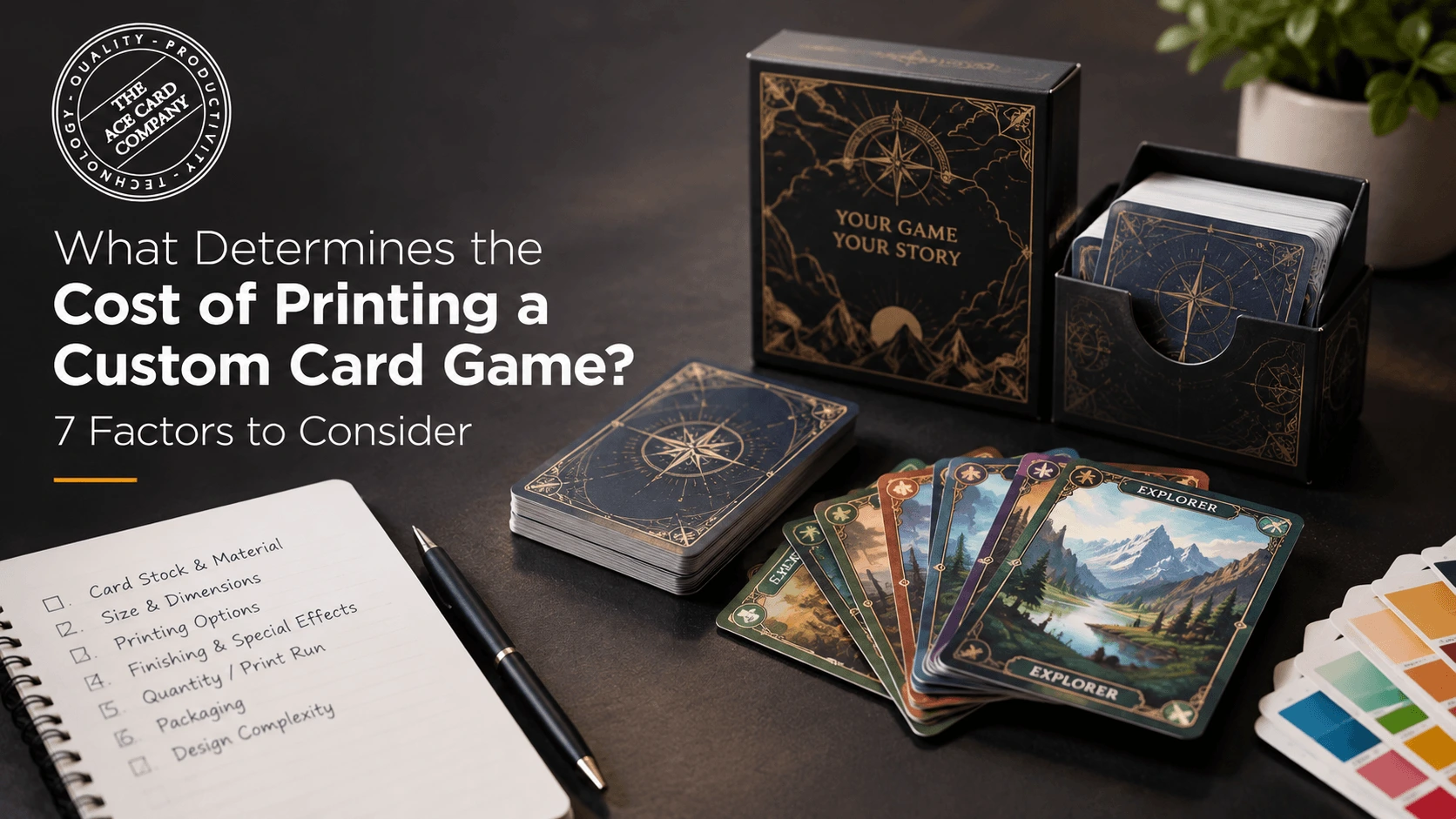
What Determines the Cost of Printing a Custom Card Game? 7 Factors to Consider
Creating a custom card game involves more than designing cards and sending the artwork to a printer. You also need to consider the number of cards, printing quantity, materials, finishes, packaging, and production requirements. Each decision can affect the final manufacturing cost.
Understanding these factors before production helps you plan your budget, compare printing options, and avoid unexpected expenses. Whether you are developing a tabletop game, an educational card deck, or a product for your business, knowing what influences the price makes it easier to choose the right specifications.
In this guide, we explain seven important factors that determine the cost of printing a custom card game and share practical tips for planning a project efficiently.
Quick Answer: What Determines the Cost of Printing a Custom Card Game?
The cost of printing a custom card game depends primarily on the order quantity, number and size of cards, card stock, printing requirements, finishing options, packaging, and additional production services. Larger orders can reduce the cost per deck, while premium materials, complex packaging, and special finishes can increase the total price. The most suitable option depends on your design, budget, intended use, and production requirements.
Why Does Understanding Card Printing Costs Matter?
A clear understanding of production costs helps you make informed decisions before committing to manufacturing. It also helps you distinguish between a low initial quote and a solution that offers the right balance of quality, durability, and value.
For independent game designers, production costs influence the price at which a game can be sold. For businesses creating promotional decks, they affect campaign budgets and distribution plans. Educational publishers may need to balance durability with affordability, particularly when ordering multiple decks.
Planning these details early can also prevent expensive changes after artwork approval. For example, changing card dimensions after designing the packaging may require adjustments to both the cards and the box.
7 Factors That Affect the Cost of Printing a Custom Card Game
1. Order Quantity
The number of decks you order is one of the most important pricing factors.
Printing equipment requires preparation, setup, and production time. When these costs are distributed across a larger order, the cost per deck can decrease. This is why bulk card printing often offers better per-unit pricing than very small production runs.
However, ordering more decks is not automatically the cheapest decision overall. A large order requires a higher initial investment and creates additional storage and inventory considerations.
How to plan your quantity:
- Estimate realistic demand before placing an order.
- Consider whether the game will be sold, distributed, or used internally.
- Compare quotes for several quantities rather than choosing only the smallest or largest option.
- Account for storage space and the possibility of unsold inventory.
The best quantity is one that balances unit cost with your expected demand and available budget.
2. Number of Cards in Each Deck
A custom card game might contain a compact set of cards or a much larger collection with multiple categories, instructions, and special cards.
More cards generally require more material and printing capacity. They can also increase cutting, sorting, collation, and packing requirements. A deck containing 30 cards will not necessarily cost the same to manufacture as a deck containing 100 cards, even if both use the same dimensions and materials.
Before requesting a quote, determine the exact number of cards in the base game. Include reference cards, promotional cards, player aids, and other printed components if they are part of the product.
Avoid adding cards without a clear gameplay purpose simply because additional content seems useful. A well-planned deck can deliver the intended experience without unnecessary production complexity.
3. Card Size and Shape
Card dimensions influence material usage, cutting requirements, and packaging design.
Standard rectangular cards are generally straightforward to produce. Unusual dimensions, custom shapes, rounded corners beyond standard specifications, or additional cutting requirements may affect production costs.
Size also influences usability. Small cards may work well for compact reference information, while larger cards can provide more room for illustrations, instructions, or detailed gameplay elements.
When selecting dimensions, consider:
- How comfortably players can hold and shuffle the cards.
- Whether text and illustrations remain readable.
- How the cards will fit inside the chosen box.
- Whether the design requires a standard or custom format.
Choosing the right size early helps avoid artwork revisions and packaging adjustments later.
4. Card Stock and Material Quality
Card stock affects the appearance, handling, and durability of a finished deck. It is also an important part of the manufacturing budget.
Different materials offer different characteristics. A thinner stock may suit lightweight promotional cards, while a more substantial stock may be preferable for games that will be handled frequently.
When comparing materials, consider flexibility, opacity, surface texture, durability, and how the cards feel during play. The best choice depends on the intended use rather than thickness alone.
For example, a classroom card deck may need to withstand frequent handling, while a limited-edition collector’s deck may place greater emphasis on presentation and perceived quality.
Ask your manufacturer which materials are available for your project and whether physical samples can be provided. Comparing samples is often more useful than relying on descriptions alone.
5. Printing Requirements and Artwork Complexity
Printing costs can vary according to the production method, color requirements, artwork preparation, and the number of distinct card designs.
A deck with a different illustration on every card may require more complex file preparation and quality checks than a deck that repeats a small number of designs. Full-color printing, double-sided artwork, and detailed graphics also need to be specified clearly.
The actual cost difference depends on the printing process and the manufacturer’s workflow. Unique artwork does not automatically mean that every card requires a separate print setup.
To prepare artwork efficiently, make sure your files meet the printer’s requirements for dimensions, bleed, resolution, color settings, and safe areas. Keep text away from trim edges and check that important details remain legible at the final card size.
Print My Game provides information about its custom game card printing options to help game creators explore suitable production specifications.
6. Finishes and Additional Features
Finishing options influence both the appearance and handling of a custom card deck.
Depending on the available manufacturing options, you may be able to choose matte or gloss finishes, textured surfaces, protective coatings, or other treatments. Some finishes may improve resistance to everyday handling, while others are primarily intended to create a particular visual effect.
Special finishes, such as foil accents or embossing where available, can add production steps and increase costs. Their value depends on whether they contribute meaningfully to the product.
For a frequently used game, practical handling and durability may be more important than decorative effects. For a premium gift or collector’s edition, selected finishes may help establish a distinctive presentation.
Compare standard and premium options before making a decision. If possible, review physical samples to understand how the finish affects color, texture, readability, and handling.
7. Packaging and Additional Components
Packaging is another important part of the total manufacturing cost. A custom card game may use a simple tuck box, a rigid box, or a more elaborate presentation package, depending on the product and available manufacturing options.
A basic box may be sufficient for a compact game intended for everyday use. A premium edition may require stronger construction, a custom insert, or additional space for instructions and other components.
Packaging costs can depend on material, dimensions, printing, finishing, assembly, and the complexity of the design. A larger box may also increase shipping and storage requirements.
Before finalizing the packaging, confirm the finished dimensions of the complete deck. Consider whether the box must accommodate a rulebook, tokens, score sheets, or expansion cards.
Designing the cards and packaging together helps prevent fit problems and unnecessary redesign costs.
Comparing Custom Card Game Printing Options
The following comparison illustrates how different production choices can influence a project. Actual prices and savings depend on the manufacturer’s equipment, specifications, and quotation.
| Production choice | Potential cost effect | Best suited for |
| Small order quantity | Higher cost per deck in many cases | Prototypes and limited runs |
| Larger order quantity | Potentially lower cost per deck | Established demand and bulk distribution |
| Standard card dimensions | May simplify production | Most conventional card games |
| Premium card stock | May increase material costs | Frequently handled or premium decks |
| Special finishes | May add processing costs | Collector’s editions and premium products |
| Custom rigid packaging | May increase packaging costs | Gift sets and premium presentations |
| Simple packaging | May reduce complexity | Practical, budget-conscious products |
How to Choose the Right Specifications for Your Budget
The goal is not to select the cheapest option in every category. It is to create a deck that meets your functional and commercial requirements without paying for features you do not need.
Start by defining the purpose of your game. A game intended for frequent family play may need durable cards and practical packaging. A promotional deck may prioritize affordability, while a collector’s product may justify a more premium presentation.
Next, establish your essential specifications:
- Confirm the deck contents. Finalize the card count, dimensions, and any additional components.
- Set a target quantity. Estimate demand and compare the total cost of different order sizes.
- Select suitable materials. Balance durability, handling, and appearance against the budget.
- Choose finishes carefully. Prioritize features that improve the actual user experience.
- Finalize packaging requirements. Ensure that the complete deck fits securely and can be stored or shipped appropriately.
- Request a detailed quotation. Ask which specifications are included, what costs are additional, and whether shipping, taxes, samples, or setup charges apply.
- Review the production proof. Check the artwork and specifications before approving production.
When comparing manufacturers, evaluate more than the headline price. Material quality, production requirements, communication, packaging, and delivery terms all influence the overall value of a quotation.
Once your requirements are clear, you can request a custom card game printing quote with enough detail for a more useful comparison.
Common Mistakes That Can Increase Production Costs
Several avoidable mistakes can create additional expenses during card game manufacturing.
Changing specifications late: Revising card dimensions, quantities, or packaging after approval can require new artwork or production adjustments. Finalize important decisions early.
Choosing materials without considering usage: The cheapest material may not suit a game that will be handled frequently. Consider durability alongside upfront cost.
Ordering too many decks: A lower unit price does not guarantee a lower overall investment. Base quantities on realistic demand.
Ignoring packaging requirements: A deck may not fit correctly if its final card count, thickness, or additional components have not been considered.
Submitting incomplete artwork: Incorrect dimensions, missing bleed, low-resolution images, or unreadable text can delay production and lead to revisions.
Comparing incomplete quotations: One manufacturer may include packaging or finishing while another lists these separately. Compare quotes using the same specifications and cost categories.
Tips for Managing Your Card Game Printing Budget
You can make production planning more efficient by following a few practical principles:
- Finalize the game mechanics and card list before preparing print-ready artwork.
- Use standard sizes where they suit the game and meet your design requirements.
- Request material samples when available.
- Compare multiple quantities and calculate the total investment as well as the per-deck cost.
- Choose premium finishes selectively rather than applying them to every component by default.
- Confirm packaging dimensions before approving the final design.
- Keep a written record of the agreed specifications, included services, and delivery terms.
- Allow time for artwork review, proof approval, and production.
These steps help reduce uncertainty while preserving the quality and usability of the finished game.
Frequently Asked Questions
1. How much does it cost to print a custom card game?
There is no single price for every custom card game. The total depends on order quantity, card count, dimensions, materials, printing requirements, finishes, packaging, and additional services. A detailed quotation based on your specifications is the most reliable way to establish the cost.
2. Does ordering more card decks reduce the price?
Ordering larger quantities can reduce the cost per deck because setup and production expenses may be spread across more units. However, the total order value will usually increase, so you should balance unit savings against expected demand and storage requirements.
3. What is the most affordable way to print a custom card game?
Start with a finalized card list, practical dimensions, suitable standard materials, and straightforward packaging. Compare several order quantities and avoid unnecessary finishing options. Always confirm that the lower-cost specifications still meet your quality and durability requirements.
4. Does card stock affect the cost of a custom deck?
Yes. Material type, thickness, surface characteristics, and availability can influence manufacturing costs. The appropriate stock depends on how the cards will be used, how frequently they will be handled, and the intended appearance of the finished product.
5. What information should I provide to get an accurate printing quote?
Provide the number of decks required, the number and dimensions of cards per deck, artwork and color requirements, preferred card stock, finishing options, packaging specifications, and delivery destination. Mention any booklets or additional components that need to be included.
6. Can I reduce printing costs without sacrificing quality?
Yes. You can often control costs by choosing appropriate card dimensions, planning order quantities carefully, avoiding unnecessary production complexity, and selecting finishes.